
Leaving a job is stressful enough on its own. Add a 401(k) balance sitting in limbo, and the financial to-do list gets overwhelming fast.
Here is the reality: most people have a relatively short window to make a decision that can affect their retirement savings for decades. Make the wrong move, and you could trigger taxes, penalties, and a mandatory 20% withholding you did not see coming. Make the right one, and you walk away with your savings intact, growing, and positioned exactly the way you want.
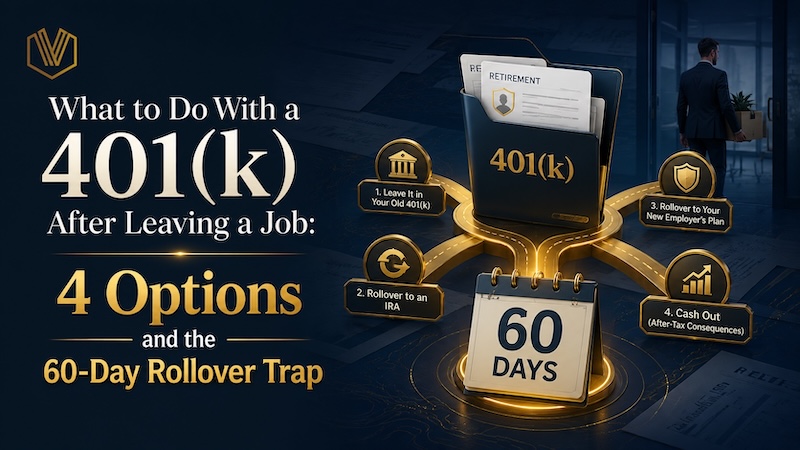
This guide covers your four real options, the IRS rules that govern each one, and the 60-day rollover trap that catches far too many people off guard.
This is not financial advice. But it is the information you need to have an informed conversation with a professional before you decide anything.
First, What Actually Happens to Your 401(k) When You Leave
Your 401(k) does not disappear when you leave a job. The money is yours. But the plan itself is managed by your former employer’s plan administrator, and they have rules about what happens next.
A few things to know immediately:
- Small balances may be forced out. If your vested balance is under $1,000, the plan can distribute it to you automatically, triggering taxes and potential penalties. Balances between $1,000 and $5,000 may be rolled into an IRA on your behalf if you do nothing.
- Large balances can stay put, temporarily. If your balance exceeds $5,000, the plan generally must allow you to leave the money there until you decide what to do. But “leaving it there” is not always the best long-term answer.
- You have options, not just one path. The IRS gives you four main routes, and choosing the right one depends on your age, tax situation, and retirement timeline.
The worst thing you can do is nothing while assuming the money is safe and growing. Plan fees, limited investment options, and the risk of losing track of old accounts are real concerns.
Your 4 Options After Leaving a Job
Here is a clear-eyed look at each path, including what the IRS says, what it costs, and who it makes sense for.
Option 1: Roll It Into a New Employer’s 401(k)
If you are starting a new job, you may be able to transfer your old 401(k) directly into your new employer’s plan. This is called a direct rollover, and when done correctly, it triggers no taxes and no penalties.
What to watch for:
- Not all employer plans accept incoming rollovers. You need to ask your new plan administrator before assuming this is available.
- Your new plan’s investment options may be just as limited as the old one.
- There is typically a waiting period before new employees can participate in a 401(k) plan, which means you may need to park the money somewhere in the meantime.
This option works best if your new employer’s plan has strong investment choices and low fees, and you want to keep everything consolidated in one place.
Option 2: Roll It Into an IRA
Rolling your 401(k) into an Individual Retirement Account (IRA) is one of the most common moves, and for good reason. IRAs typically offer a much wider range of investment options than employer-sponsored plans, including stocks, bonds, mutual funds, ETFs, and in some cases, physical assets like gold and silver through a self-directed IRA.
Key details:
- A direct rollover from a 401(k) to a traditional IRA is not a taxable event when done correctly.
- You have more control over your investment choices and often lower fees.
- If you are interested in diversifying into physical precious metals, a self-directed IRA is the vehicle that makes that possible under IRS rules.
According to IRS Publication 590-A, rollovers must generally be completed within 60 days of receiving a distribution to avoid taxes and penalties. More on that below.
Option 3: Leave It in Your Former Employer’s Plan
If your balance is above $5,000 and you are happy with the plan’s investment options, you can simply leave the money where it is. You are not required to move it immediately.
When this makes sense:
- Your former plan has unusually strong institutional investment options or very low fees.
- You are in the middle of a job transition and need time to decide.
- You are between 55 and 59½ and want access to the Rule of 55 (which allows penalty-free withdrawals from a 401(k) if you leave your job in or after the year you turn 55, a benefit that does not apply to IRAs).
The downside: You lose the ability to contribute to the old plan, and you may have limited control over investment choices. Over time, old accounts also tend to get forgotten, which creates its own complications.
Option 4: Take a Cash Distribution
You can cash out your 401(k) entirely. This is almost always the most expensive option, and in most cases, it is worth avoiding unless there is a genuine financial emergency.
Here is what happens when you take a cash distribution:
| What Happens | Details |
|---|---|
| Federal income tax | The full amount is added to your taxable income for the year |
| Mandatory withholding | Your plan is required to withhold 20% for federal taxes upfront |
| Early withdrawal penalty | If you are under 59½, an additional 10% penalty applies |
| State income tax | Varies by state, but most states will tax the distribution as well |
Example: If you have $100,000 in your 401(k) and take a full cash distribution before age 59½, your plan withholds $20,000 immediately. You then owe income tax on the full $100,000 (not just the $80,000 you received), plus a $10,000 penalty. Depending on your tax bracket, you could lose 30% to 40% of your balance in a single year.
There are limited exceptions to the 10% penalty, including total and permanent disability, certain medical expenses, and a handful of other IRS-defined hardship situations. But for most people, cashing out is the option to avoid.
The 60-Day Rollover Trap: What It Is and How to Avoid It
This is the part of the process that catches people off guard, and it is worth understanding in detail before you do anything.
When you request a distribution from your 401(k) with the intention of rolling it over yourself, the IRS gives you 60 days to deposit that money into a qualifying retirement account. Miss that deadline, and the entire amount is treated as taxable income for the year, plus the 10% early withdrawal penalty if you are under 59½.
The 20% Withholding Problem
Here is where it gets complicated. When your 401(k) plan sends you a check directly, federal law requires them to withhold 20% for taxes, regardless of your intention to roll it over.
That means:
- You request a $100,000 distribution to roll over yourself
- Your plan sends you a check for $80,000 (withholding $20,000)
- To complete a valid rollover and avoid taxes, you must deposit the full $100,000 into your IRA within 60 days
- You have to come up with the missing $20,000 out of pocket
If you only deposit the $80,000 you received, the $20,000 that was withheld is treated as a distribution, taxed as income, and potentially hit with the 10% penalty. The withheld amount will eventually be refunded when you file your taxes, but only after you have already paid the price for the shortfall.
The Simple Fix: Request a Direct Rollover
The cleanest way to avoid this entire situation is to never touch the money yourself. A direct rollover (also called a trustee-to-trustee transfer) moves funds directly from your old plan to your new IRA or 401(k) without the money ever passing through your hands.
No check. No withholding. No 60-day clock. No risk.
According to IRS Topic No. 413, direct rollovers are not subject to withholding and are not treated as distributions. This is the recommended approach for the vast majority of people.
One More Limit to Know
The IRS also limits indirect rollovers (the kind where you receive the money and then redeposit it) to once per 12-month period across all your IRAs combined. This is a separate rule from the 60-day deadline and applies even if you complete the rollover on time. Breaking this rule turns the second rollover into a taxable distribution.
How to Compare Your Options Side by Side
Every situation is different, but this comparison gives you a starting framework.
| Option | Taxes Triggered? | Penalty Risk? | Investment Flexibility | Best For |
|---|---|---|---|---|
| Roll into new employer 401(k) | No (if direct) | No | Limited to plan options | Simplicity, keeping accounts consolidated |
| Roll into IRA | No (if direct) | No | High (stocks, bonds, ETFs, precious metals) | Flexibility, broader diversification |
| Leave in old plan | No | No | Limited to old plan options | Rule of 55 access, temporary holding |
| Cash distribution | Yes | Yes (under 59½) | N/A | Genuine financial emergency only |
The bottom line: For most people leaving a job, rolling into an IRA via direct rollover gives the most flexibility, the lowest cost, and the fewest complications. It is also the path that opens the door to a self-directed IRA if you want to include physical assets like gold or silver in your retirement strategy.
What About Rolling Into a Gold or Silver IRA?
If you are rolling a 401(k) into an IRA and considering physical precious metals as part of your retirement strategy, a self-directed IRA is the IRS-approved structure that makes that possible.
A self-directed IRA works like a traditional IRA in terms of tax treatment, but it allows you to hold a broader range of assets, including IRS-approved physical gold and silver, rather than being limited to stocks, bonds, and mutual funds.
IRS Rules for Precious Metals in an IRA
Not every gold or silver product qualifies. The IRS has specific purity and form requirements:
- Gold must be at least 99.5% pure (with the exception of American Gold Eagle coins, which are 91.67% pure but still IRS-approved)
- Silver must be at least 99.9% pure
- Platinum and palladium must be at least 99.95% pure
- Metals must be held by an IRS-approved custodian and stored in an approved depository. You cannot store IRA-owned gold at home.
The rollover process itself follows the same rules as any other 401(k)-to-IRA rollover. Direct is cleaner, the 60-day rule applies to indirect rollovers, and no taxes are triggered when done correctly.
Why some people consider this: Physical gold and silver have historically behaved differently from stocks and bonds during periods of inflation or market stress. For people who want a portion of their retirement savings in an asset that is not tied to the performance of financial markets, a self-directed IRA with physical metals can be one piece of a broader diversification strategy.
This is not a recommendation that precious metals are right for your situation. Every investor’s circumstances are different, and the right mix of assets depends on your timeline, tax situation, and overall financial plan. That is a conversation worth having with a qualified specialist.
Frequently Asked Questions
How long do I have to decide what to do with my 401(k) after leaving a job?
There is no universal deadline for making your decision, but there are time-sensitive rules to be aware of. If you take a distribution directly, you have 60 days to roll it into a qualifying retirement account to avoid taxes and penalties. If you leave the money in your former employer’s plan, you can generally keep it there as long as the balance is above $5,000, though the plan may eventually require you to move it.
What is the difference between a direct rollover and an indirect rollover?
A direct rollover moves money from your old plan directly to your new IRA or 401(k) without passing through your hands. No taxes are withheld, and no 60-day deadline applies. An indirect rollover sends a check to you, which your plan is required to reduce by 20% for withholding. You then have 60 days to deposit the full original amount (including the withheld portion) into a qualifying account to avoid taxes.
Can I roll my 401(k) into a Roth IRA?
Yes, but it is a taxable event. Rolling a traditional pre-tax 401(k) into a Roth IRA is called a Roth conversion. The amount converted is added to your taxable income for the year. Some people do this intentionally to lock in today’s tax rates and enjoy tax-free growth going forward, but it requires careful planning with a tax professional.
What happens if I miss the 60-day rollover deadline?
The distribution is treated as taxable income. If you are under 59½, a 10% early withdrawal penalty also applies. In limited circumstances, the IRS may grant a waiver, such as in cases of financial hardship, hospitalization, or postal errors, but these exceptions are narrow and not guaranteed.
Can I roll a 401(k) into a Gold IRA?
Yes. A 401(k) can be rolled into a self-directed IRA, which can hold IRS-approved physical gold, silver, platinum, and palladium. The rollover follows the same rules as any other IRA rollover. The metals must meet IRS purity standards and be held by an approved custodian in an approved depository.
What if I have multiple old 401(k)s from different jobs?
Each account can be rolled over separately. You can consolidate them into a single IRA if you choose, which simplifies management and may reduce fees. The once-per-year limit on indirect rollovers applies across all your IRAs combined, so if you are doing multiple rollovers, direct rollovers are the safest approach.
Ready to Talk Through Your Options?
A 401(k) rollover is one of those decisions where the mechanics are straightforward, but the right answer depends entirely on your personal situation: your age, your tax bracket, your timeline, and what you want your retirement to look like.
If you are weighing a rollover into a self-directed IRA that includes physical gold or silver, our specialists are happy to walk you through how it works. Including what it costs, and whether it makes sense for where you are in life. No pressure, no sales pitch. Just a real conversation.
Call us at 877-330-3228 or visit vaultmetal.com to schedule a free consultation.
Disclaimers
Financial Disclaimer: The content on this page is for informational and educational purposes only and does not constitute financial, tax, or investment advice. All investments carry risk, including the potential loss of principal. Precious metals, like all assets, can fluctuate in value. Past performance does not indicate or guarantee future results. Before making any investment or rollover decision, consult a licensed financial advisor, tax professional, or other qualified professional who can evaluate your individual circumstances.
AI Disclaimer: This article was created with the assistance of artificial intelligence tools and has been reviewed for accuracy and compliance. Vault Metal is committed to transparency in how its content is produced.